

How Russell Kirk Found Conservatism at Duke
A chronicle of Russell Kirk’s (no relation to Charlie) time as a master’s student in history, 1940–41.

Who would’ve thought that Duke University—a school that is today suffused with the liberal utopianism of surrounding Durham, a place where only 10-15% of faculty and students identify as conservative—first introduced America’s greatest conservative, Russell Kirk, to conservatism?
I certainly didn’t.
To anyone who knows the thought of Russell Kirk as outlined in masterworks like The Conservative Mind and The Roots of American Order, it should come as no surprise that he studied at Duke. After all, it was Kirk who adored the particularism and anti-majoritarianism of Southern thinkers like Calhoun and Randolph; he not only wrote his master’s thesis on John Randolph, but dedicated an entire chapter of The Conservative Mind to their philosophies.
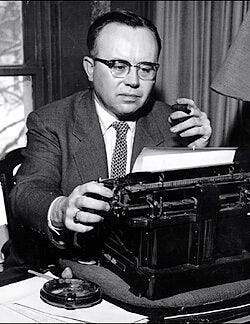
Be that as it may, there are far more reasons why a recent graduate like myself would be completely ignorant of the fact that Kirk studied at Duke. I spent a long four years traipsing the halls of Duke’s Gothic campus, yet I did not once encounter a mark of his legacy—something that was certainly not a result of a lack of trying on my part.
There is no Russell Kirk Scholarship program at Duke. No Kirk Center for the Study of Southern Thought. No Kirk building. No portrait in a dusty back corner of a library à la Nixon. No mention of him in the recent Centennial celebrations. Not even a name plastered to one of those high-tech meeting spaces that apparently cost tens of thousands to construct. Until recently, there was not even any discussion of Kirk’s legacy in Duke’s classrooms. In fact, it took an outside, conservative non-profit to fund a course on the intellectual development of American conservatism just to have the father of American conservatism even be mentioned at his alma mater (shout out to Dr. Coome)! [and Barnes & Noble wants to call The Handmaid’s Tale a “banned book.”]
The only modicum of recognition Kirk ever received from the university was an offer for the “Most Distinguished Alumnus award” in 1989—something Kirk declined on account of “previous engagements.”
Ironically, then, Kirk’s conservative mind has not been conserved, at least on the rainbow-lined streets of Durham. This man who exhorted a generation of Americans to honor the things of old has been, unceremoniously, written out of the very history of the place he once trod. And, as easy as it would be to merely lament this fact or highlight how a similar fate would never befall a liberal intellectual of equal stature, such efforts do little in the way of honoring Kirk’s legacy. What is needed is not a rebuttal of the revisionists but a recovery of Kirk himself.
The purpose of this essay is thus to rebuild Kirk’s Duke legacy by reconstructing his brief stopover in Durham—and, more importantly, to show how this otherwise unhappy year helped Kirk discover the intellectual tradition that would eventually become his conservatism.
I will first introduce Kirk as we know him today, briefly outlining his life and political thought, before diving into his year at Duke. This essay was pieced together from a series of Kirk’s private letters and writings, biographies, and other publicly available information. For those interested in reading more about Kirk or his time at Duke, I will include a “Further Reading” section at the bottom of this post. I hope y’all enjoy!
Who Was Kirk?
Before I can take you through Russell Kirk’s year at Duke, it’s worth explaining, however briefly, who he was in his day. Kirk was, to put it simply, the father of American conservatism. Born in Plymouth, Michigan, in October 1918, Kirk spent the vast majority of his life, from his stately home on Piety Hill, expositing a political philosophy defined by prudence, humility, respect for tradition, and, ultimately, trust in divine Providence.
Though Kirk published many impactful books, his most influential was an adaptation of his doctoral dissertation from the University of St. Andrews, The Conservative Mind, published in 1953. Over the course of about five hundred pages, Kirk walks readers through a scattershot history of the leading Anglo-American conservative thinkers from the last two or so centuries—beginning with Kirk’s muse, Edmund Burke, and ending with the man he called the “principal conservative thinker in the twentieth century,” T.S. Eliot. The Conservative Mind was, and still is today, the lodestar for the American conservative movement. Not only did it rocket conservatism into the mainstream of American politics, thanks to its generous media coverage upon publication, but it also proved to a generation of Americans that conservatism is not merely regressive. He showed, with aggressive precision, that conservatism has substance. The most accessible example of this is the six canons of conservatism Kirk included in the book’s first chapter:
“1) Belief in a transcendent order, or body of natural law, which rules society as well as conscience. Political problems, at bottom, are religious and moral problems. […] 2) Affection for the proliferating variety and mystery of human existence. […] 3) Conviction that civilized society requires orders and classes. […] 4) Persuasion that freedom and property are closely linked. […] 5) Faith in prescription and distrust of “sophisters, calculators, and economists” who would reconstruct society upon abstract designs. Custom, convention, and old prescription are checks both upon man’s anarchic impulse and upon the innovator’s lust for power. […] 6) Recognition that change may not be salutary reform: hasty innovation may be a devouring conflagration, rather than a torch of progress. […]
But, more than that, Kirk demonstrated that conservatism has a mind and an active one at that—evidenced by the political and literary careers of the men he drew into his canon in the book. For these reasons and more, The Conservative Mind has come to occupy the same place in the heart of intellectual conservatives as Das Kapital does for Marxists or Locke’s Second Treatise for classical liberals.
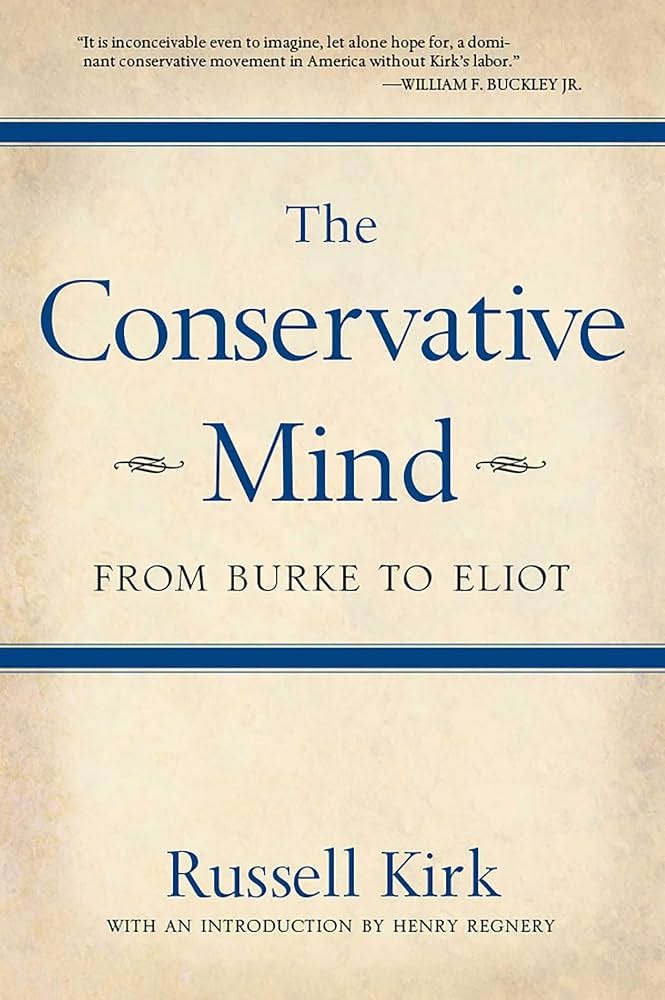
In light of Kirk’s monumental intellectual achievement, Alfred Regenery, the son of Henry Regenery, the man who originally published The Conservative Mind, described this work as “the catalyst that began the transformation of a band of disparate conservative critics into the political, cultural, and intellectual force that it is today.” And catalyze it did. Within two years of The Conservative Mind taking the nation’s intellectual elite by storm, Kirk had joined with other prominent conservatives like William F. Buckley to found National Review in 1955—where he would serve as a regular contributor for decades.
Throughout his lengthy career, Kirk not only wrote masterworks of conservative political philosophy, books like The Roots of American Order, but also helped establish an institutional infrastructure that would outlast his mortal life. By the time of his death in 1994, Kirk had founded magazines and prominent scholarly journals, mentored innumerable young conservatives at institutions such as the Intercollegiate Studies Institute, and sometimes even explicitly participated in right-wing politics—for example, when he served as the chair of Pat Buchanan’s 1992 Michigan primary campaign.
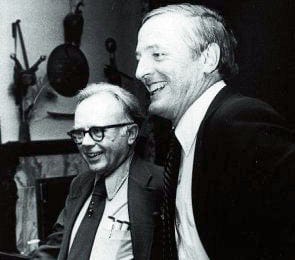
These accomplishments ultimately led President Ronald Reagan to name Kirk “the prophet of American conservatism, Russell Kirk has taught, nurtured, and inspired a generation.”
What About Duke?
The factors that led Russell Kirk to attend Duke are perhaps too numerous to list. The young Kirk apparently had no real interest in Southern history or politics. As his biographer Bradley Birzer explains, Kirk was essentially raised on whatever works his mother, Marjorie Rachel Pierce Kirk, could give him. This included everything from the romantic tales of the Brothers Grimm and Lewis Carroll to the more mature works of Victor Hugo, Charles Dickens, Mark Twain, and Shakespeare. While a modern reader may find an upbringing that exposes a young man to these sorts of writers a bit aristocratic, the Kirk family was anything but. In fact, so poor were the Kirks’, that there was a point during the Great Depression when the total of the family’s worth was a $20 bill kept as a bookmark in his mother’s copy of Kipling’s The Light That Failed.
Poor though they were, Kirk was not raised solely by his parents. His maternal grandfather, along with his mother, most shaped the young man, always discussing esoteric topics like “the character of Richard III, and of Puritan domestic life, and the ferocity of the Assyrians” during their long walks around his property.
As surprising as it may sound, Kirk was quite fond of his public education. He was exposed to all manner of topics like history, literature, Latin, business law, arithmetic, and science. This, of course, was a bit of a holdover from earlier, late-nineteenth-century public education practices and did not reflect the leveling efforts of John Dewey. In light of his relative educational luck, Kirk said, “I crossed the drawbridge just before the portcullis fell.”
His formal and informal schooling ultimately led Russell Kirk to enroll at Michigan State College in the fall of 1936. While an entire essay could be written about his time in Lansing, there are only a few things worth noting here. The first is that Michigan State, through his literature professor, John Abbott Clark, introduced Kirk to the thought of eminent conservative writers Irving Babbitt and Paul Elmer More. Kirk’s biographer summarized their contribution to Kirk’s thought thusly: “In essence, Babbitt and More wanted to remind men and women what it meant to be human and a part of a continuity of the past, the present, and the future.” Secondly, his time in college demonstrated Kirk’s immense intellectual ability. Most notably, he published two scholarly articles while still an undergraduate—one of which was so deftly molded that editors of College English mistook him for an “instructor in history at Michigan State College!”
These four years at Michigan State gave Kirk many of the raw materials of his later conservatism, particularly his admiration for Babbitt and More. But the pieces had not yet formed a coherent political philosophy. That would begin to happen at Duke.
Yet, like every fresh graduate in America, Kirk still had yet to slay the great dragon before him—he was jobless. And, to make matters worse, the nation was still in the midst of the Great Depression. This really left the young man with few options. Either he returns home to Michigan and plies some trade that he would doubtlessly loathe or, if possible, enters academia. Now, as anyone who has attempted to “enter academia” can tell you, this is not always an easy feat.
“Graduate study was a possibility—not a very desirable prospect, just then, but a tolerable one,” Kirk wrote in his memoir The Sword of Imagination. Indeed, Kirk did not exactly want to become an academic or graduate student, but the Great Depression and perhaps his frenetic mind forced his hand. Kirk applied and was offered admission to just two master’s programs in History, one at Pennsylvania State and the other at Duke. Though he was still a bit uncertain what he thought of a career in academia, Kirk knew that “the degree snobbery of academia” would require of him more than a mere bachelor’s if he wanted to remain in what he called “the petrified forest of academe.”
Ultimately, Kirk would accept the offer from Duke, which included a tuition waiver, no real teaching duties, and “a modest sum” of two hundred dollars—what the ever-humble Kirk termed “wealth beyond the dreams of avarice.”
The Duke of 1940
A. Campus Culture
Duke, at the time of Kirk’s arrival, was not unlike the fledgling American Republic at the height of the Virginia dynasty (the first two decades of the nineteenth century). It had everything an upstart, bold institution needed. Duke had heaps of money due to the generous Duke endowment created by James Buchanan Duke in 1925; a pioneering titan of education in University President William Preston Few (who sadly died in October 1940); and the look of an old, Gothic campus thanks to the craftsmanship and foresight of Julian Abele and James B. Duke.
New buildings were going up everywhere on campus. In just the year of 1939, a new addition had been added to Duke Hospital, a section of the Few Quadrangle, and, most importantly, the home of the world’s most infamous college basketball fans, Cameron Indoor Stadium (then known as Duke Indoor Stadium).
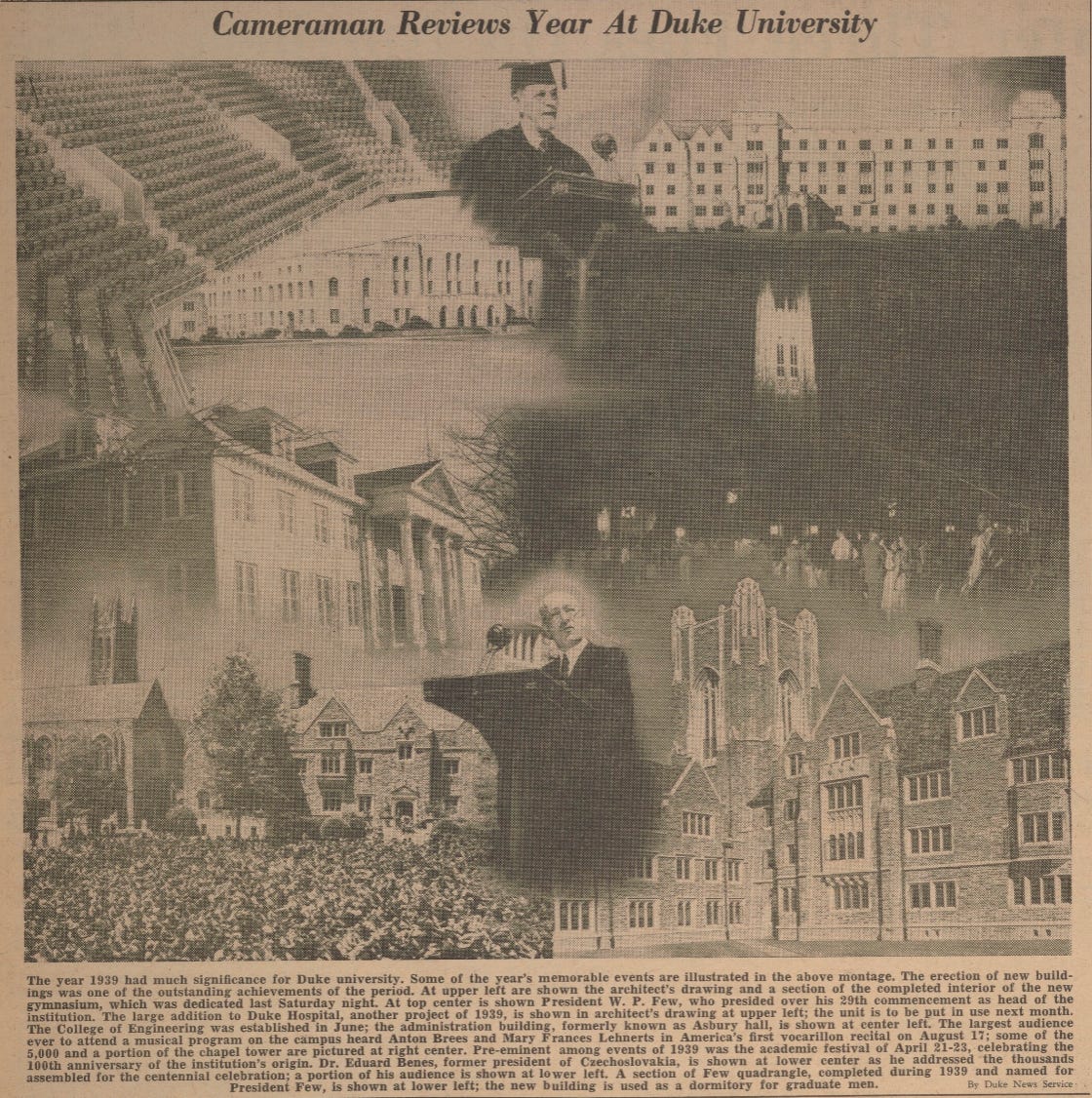
It was this architecture that seemed to impress the young Russell Kirk most. Writing in his memoir, Kirk recalled (in the third person):
“the tall Gothic buildings of Duke emancipated Kirk from his Michigan provinciality. For austere study, he could not have made a better choice. Duke proper was for men only, the girls being at associated Trinity College, some distance away among the loblolly pines; the odorous tobacco town of Durham, which had few attractions, was yet more distant.”
If it is not evident from this glowing praise, Kirk felt what Julian Abele wanted him to feel—as if the campus were old, reverent, and fit for capacious young minds like his. He did not feel at home, of course. But one could certainly say that the physical setting of Duke lifted Kirk’s mind above the trees to gaze upon the affairs of men and possibly even encounter the guiding hand of Providence. It’s difficult to overstate how important this was to the young Kirk’s thought. He would later become the pre-eminent thinker in a tradition that holds that places, institutions, architecture, manners, and inherited customs shape the people who inhabit them. In that sense, Duke was already teaching Kirk something that he would later spend his career arguing: that the physical and cultural inheritance of a civilization can educate the mind before the mind has learned to articulate why it matters.
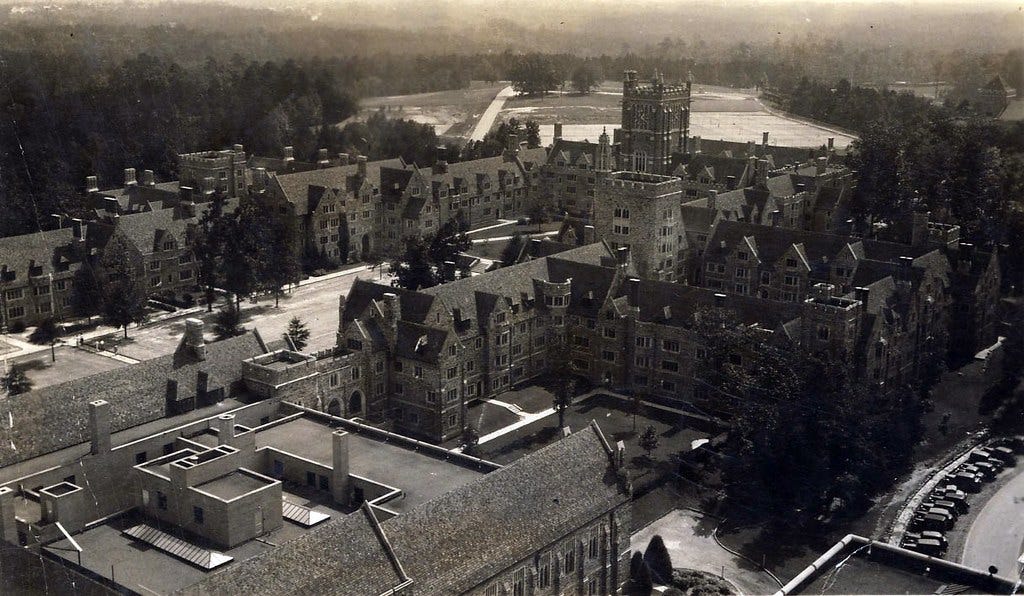
This Duke that enchanted Kirk was not the Duke of 2026. There are some obvious examples of this, with the campus being racially and sexually segregated. Yet there are subtler points worth touching on. The campus was patriotic and conservative. As Kirk noted in an October 25th, 1940, letter to a friend:
“All these Southerners have been reading Boston and New York and Chicago history texts these many years, and think Lincoln was the great American political philosopher. The Willkie cause is strong here at Duke.”
A Duke Chronicle poll around the time of Kirk’s letter confirmed the Republican bent of the student body, showing a 292-vote margin for Willkie. Students still organized Old South-style “Yankee-Reb” balls where young men vied for the hand of freshmen girls. And President Few, himself educated in the classics, often spoke about the duties of citizenship and the glories of the American cause. “Our inheritance of English civilization, of English institutions, of English ideals, and of participation in English life should have supreme significance for us,” Few remarked to a gathering at the Women’s college. Few continued, “We are under very fortunate circumstances in the greatest republic in history, under a government which leaves its citizens free to do their best for the general welfare, to rise to their full stature, and to live the fullest possible life.” One could only imagine the outrage these remarks would cause today if President Price delivered them!
Yet, like its architecture that so profoundly “emancipated” Kirk, many aspects of the Duke of 1940 were similar to today’s campus culture. About half of the students, on Kirk’s rendering, came from the North—although the Northerners of Kirk’s day possessed “Southern civility.” Greek life was thriving, with 168 freshmen pledging 18 fraternities in the spring of 1941. The Duke Chronicle was similarly active, publishing a semiweekly print edition on everything from local concerts to campus scandals. The university was also peculiarly tolerant of other Christian denominations for a Southern school. The best evidence of this is the formation of a large Catholic Club of about 200 students around 1939.
Most similar of all to today’s Duke was the campus’ lively sports culture. However, it was Duke football, not basketball, that led the way. The team, led by the modern stadium’s namesake Wallace Wade, won unofficial national championships in 1936 and 1941 and, in an ode to Manny Diaz, came out victorious in just about every Southern Conference championship from 1933-1943 (excepting ’34, ’37, ’40, and ‘42). Under Wade’s leadership—a future College Football Hall of Fame inductee—Duke’s football team would play in two Rose Bowls and has generally been recognized by sports writers as one of the greatest teams in college football history [do not ask me for a source on this ;)].
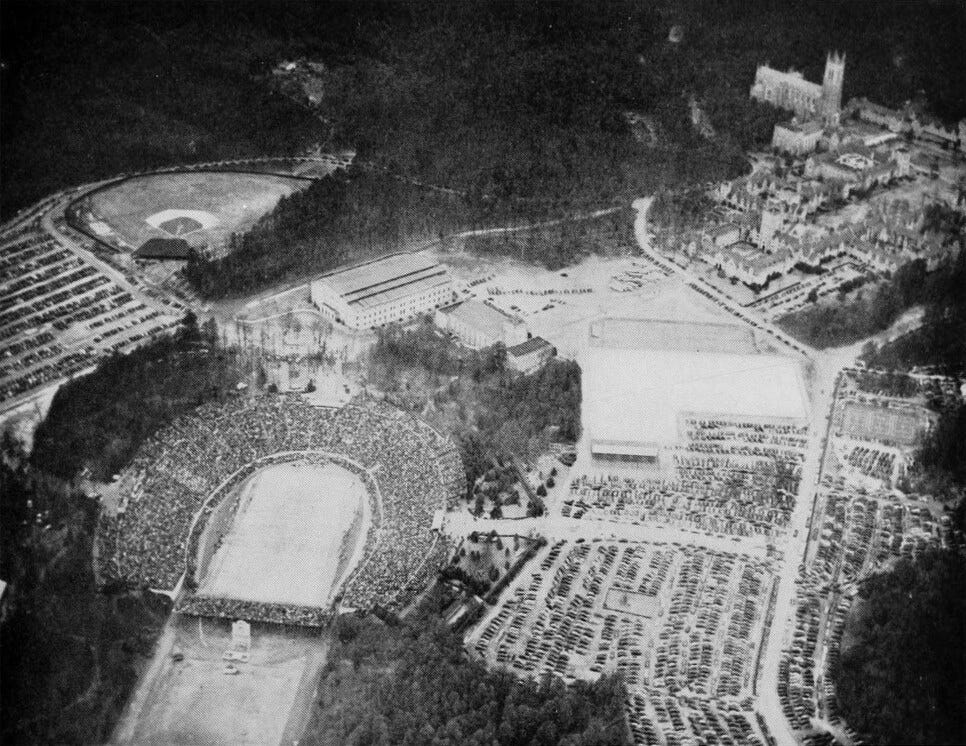
You can look at really any edition of the Duke Chronicle during this era to get a sense of this lively environment that Kirk would have experienced during his year at Duke. Perhaps my favorite example of this came during a fall 1940 football game vs V.M.I. In an October 1st, 1940, article titled “Patriotism Appears in Duke-V.M.I. Fray,” a student wrote:
“Everything was very patriotic last Saturday…from the playing of the ‘Star-Spangled Banner’ and ‘God Bless America’ to the uniforms on the field…V.M. wore red pants, the referees supplied the white, and the Devils were attired in their usual blue. After the first team tallied so rapidly via the air, someone in the stands was heard to remark that it looked like a ‘blueskrieg.’” Duke won 23-0. Maybe 1940 Duke wasn’t so similar to today’s, in more ways than one…
B. Duke During the War
A keen reader will note that all of this talk of patriotism and “blueskrieg” is coming during a time when the Nazi war machine was ravaging Europe. This was something that Americans, including Duke students, were incredibly aware of and opinionated about. In fact, Dr. Eduard Benes, the former president of Czechoslovakia, addressed Duke’s centennial celebrations in 1939. As any World War II buffs will know, Dr. Benes was in office during the time of the ill-fated Munich Agreement of 1938, which effectively forced Benes and the Czechs to cede the Sudetenland to the Third Reich. Following the collapse of his pro-Western foreign policy, Benes resigned on October 5th of that year and began lobbying for Czech abroad.
Kirk’s memoirs and diaries offer little insight into his feelings about the war while at Duke. The closest thing to an opinion on the conflict comes from that October 25th letter Kirk wrote to his friend:
“The Willkie cause is strong here at Duke; however, I am happy to say. Remember to get out all your henchmen to vote next week—and not for the Country Squire (FDR). Willkie made a spirited defense of states’ rights yesterday, I see. Glad to be able to cast my first vote for him. I think we’ll win.”
For all of his talents, Kirk was not endowed, at least in the fall of 1940, with the gift of political foresight. Willkie was demolished in the 1940 election. Yet, Kirk’s vehement support for Willkie, especially when taken in the context of later writings, suggests he supported involvement in Europe and elsewhere. Willkie, like FDR, was a kind of liberal internationalist whose critiques of FDR’s handling of programs like the “destroyers for bases” program were typically procedural and not substantive.
Kirk’s Studies
“He being in the South, it behooved Kirk to acclimate himself by studying Southern history and Southern literature. In this, Providence seemed to lend Kirk a hand,” so wrote Russell Kirk in his memoir. That providential hand came in many forms.
Its first instance was that of two nationally acclaimed faculty who just so happened to share Kirk’s conservative way of thinking: Southern historian Charles Sydnor and Southern literary critic Jay Hubbell. Though Kirk “never had heard of them until he arrived at Duke,” he quickly acquainted himself with the two and their areas of expertise. Kirk described the two scholars in his memoir, The Sword of Imagination, as “Southern gentlemen and scholars of the old breed, courteous and friendly to those deserving of friendship.”
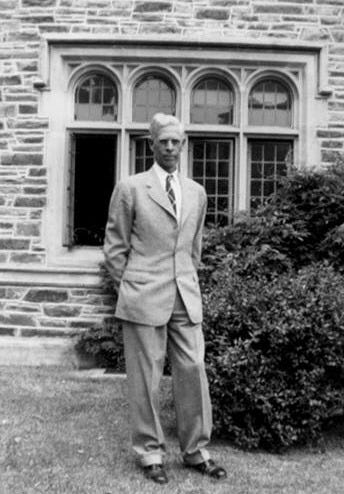
Whatever their ideological alignment, it seems, from Kirk’s personal letters and other writings, that Drs. Sydnor and Jay Hubbell did not exert a profound role in his intellectual journey and primarily served as career mentors and friends to the burgeoning scholar. That said, these men were unabashedly Southern conservatives tied to the old way of life of the South. Kirk especially enjoyed a course on Southern literature and culture from 1800-1870 that he took with Dr. Hubbell.
At this point and through these engagements with Drs. Hubbell and Sydnor, it would be fair to say that Kirk’s generally conservative leanings and suspicions of modernity acquired a place, a people, and a political tradition: the South.
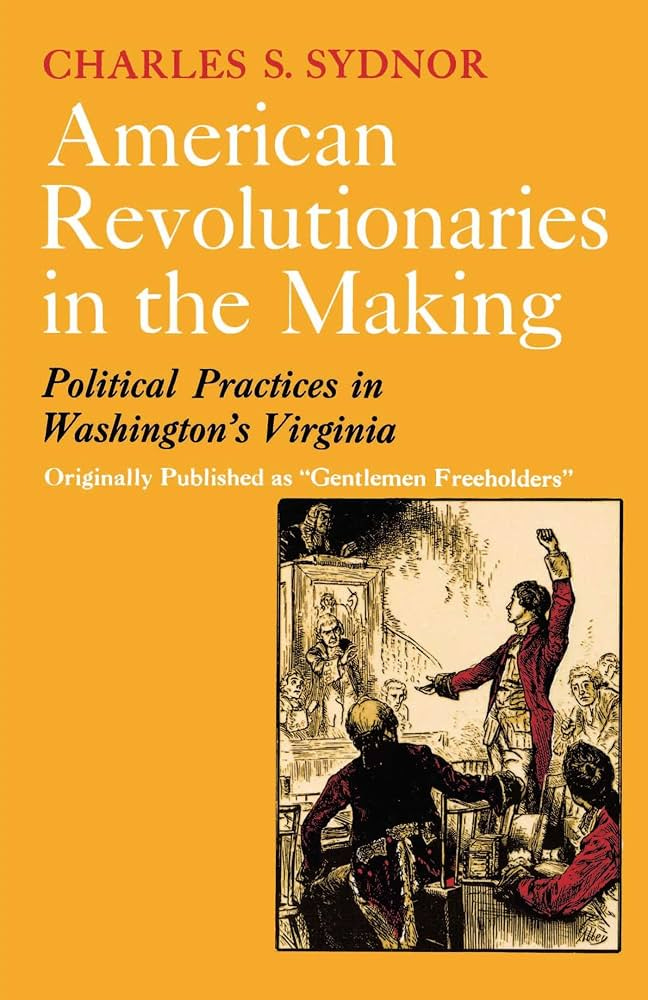
Those familiar with the relatively niche intellectual conservative literary canon may recognize Dr. Sydnor’s name. His 1952 work, American Revolutionaries in the Making: Political Practices in Washington’s Virginia, has become a bit of a cult classic in those circles, owing to its staunchly conservative, dare I say localist appraisal of colonial Virginian politics. That sort of political environment—one where men were forced to debate face-to-face and engage in the practical art of statesmanship—produced precisely the kinds of prudent statesmen that the burgeoning republic would need. Moreover, Sydnor argued that this democratic politics, coupled with the uniquely aristocratic requirements on voting and officeholding, created a near-perfect mixture of astute intellect mediated by popular accountability. Kirk would pick up on many of these themes in his later works, particularly in his chapters on John Adams and the “Southern Conservatives” in The Conservative Mind.
Though Kirk enjoyed the company of Sydnor and Hubbell, as well as some classmates, such as his sometime travel companion, Ralph Purcell, he did not, on the whole, like the faculty and students at Duke. Birzer’s biography of Kirk is quite clear on this point, noting, “although he enjoyed a few professors’ lectures, he disliked his fellow graduate students, most of whom he considered little better than lemmings.” Kirk himself said as much in a letter to a friend:
“There simply are not enough real brains in this country to fill the graduate schools which are growing every day…And these ‘scholars’ expect to teach college! A century or more back in the old days of ignorance and unenlightenment, they wouldn’t have had a chance to teach little boys in a rural school; their pupils would have known more than they.”
The young scholar thought of his fellow graduate students as “automatons, if that.” They were without agency and utterly incapable of original thought…to Kirk. While some of this may have stemmed from a cocktail of narcissism and cynicism on Kirk’s part—more likely a general frustration with his lack of an intellectual peer—this criticism was not entirely without merit. Kirk was almost certainly the most learned and well-read student in his cohort. Moreover, he was probably the freest thinker. This is something Birzer actually describes rather vividly in American Conservative, detailing a moment when Kirk debated his roommate on the literary quality of William Dean Howells and Henry James. Kirk argued that Henry Adams was a much better fiction writer, to which his roommate asked, like an annoying sibling in an early 2000s comedy, “Says who?” Shocked, Kirk responded, “I do.” Birzer details the rest:
“Aghast, the roommate protested Kirk’s assertion of authority and argued only a scholar in the field could pronounce one writer better than another.”
The silver lining of this dissatisfaction with the intellectual community at Duke—the second stroke of Providence—was that it forced Kirk into the library. Paradoxically, then, the very thing Kirk hated about Duke became one of the things that made the university intellectually formative for him. The classroom disappointed him, so he educated himself. And in educating himself, he discovered the Southern tradition that would give political shape to instincts he had previously encountered mainly in literary and philosophical form.
He had already acquainted himself with the Southern literary and political canon beforehand, reading some Southern agrarians like Davidson’s The Attack on Leviathan while at Michigan State. Still, it was really at Duke, owing to the lack of classroom enrichment, that his interest in the South took off. While in Durham, Kirk read just about everything published by James Fenimore Cooper, Sir Walter Scott, and Irving Babbitt. Later in life, Kirk would praise these Southerners for their “Christian humanism, stern criticism of the industrial mass society, detestation of communism and other forms of collectivism.”
In Perkins Library, therefore, Kirk found a home away from home. This “splendid” institution housed “six hundred thousand manuscripts,” many of which contained the personal papers of men such as Calhoun, Robert E. Lee, and Beauregard. Kirk loved Duke’s library for its connection with Chapel Hill, which gave him even more access to the writers he desired. So great was his attachment to the library that Kirk was said to have spent most of his career at Duke, when not traveling across the South, in the building. The best portrait of this time in Kirk’s life is detailed in a letter he wrote to his mother in the spring of 1941:
“I must work hard if I am to get my degree in June, and am reading two or three books a day…Write me when you can; I’ll write again soon. Must leave for the library now.”
Yet, for all of its majesty, Duke’s library system was deficient in one respect. “The one book I need most, though, isn’t here—Proceedings of the Virginia Constitutional Convention of 1829-1830. It contains Randolph’s most important speeches in the field of constitutionalism,” wrote Kirk in an October 1940 letter to a friend.
During this time in the library, among his friends in the faculty, amid the soaring Gothic architecture, and on his travels across the region to locations like Charleston and Bennett Place, Kirk became increasingly enchanted with the South. The more he read, the more he came to see in the Southern past a distinctive political and cultural inheritance, one that stood in sharp contrast to the atomized, industrial society he had come to distrust in the nation at large.
Randolph of Roanoke
It was perhaps the third move of Providence, then, that Kirk’s growing fascination with the South should lead him to one of its most idiosyncratic political thinkers: John Randolph of Roanoke. In Randolph, the disparate strands of Kirk’s intellectual life at Duke—his suspicion of industrial modernity, admiration for tradition, affection for the South, and growing interest in decentralized political authority—began to converge. Randolph offered Kirk an ideal subject through whom to explore the constitutionalism, political individualism, and agrarian conservatism that so captivated him. By the time Kirk began work on his master’s thesis, his subject was thus almost inevitable: he would turn from reading the Southern canon to examining, in depth, the political thought of one of its most brilliant and eccentric sons.
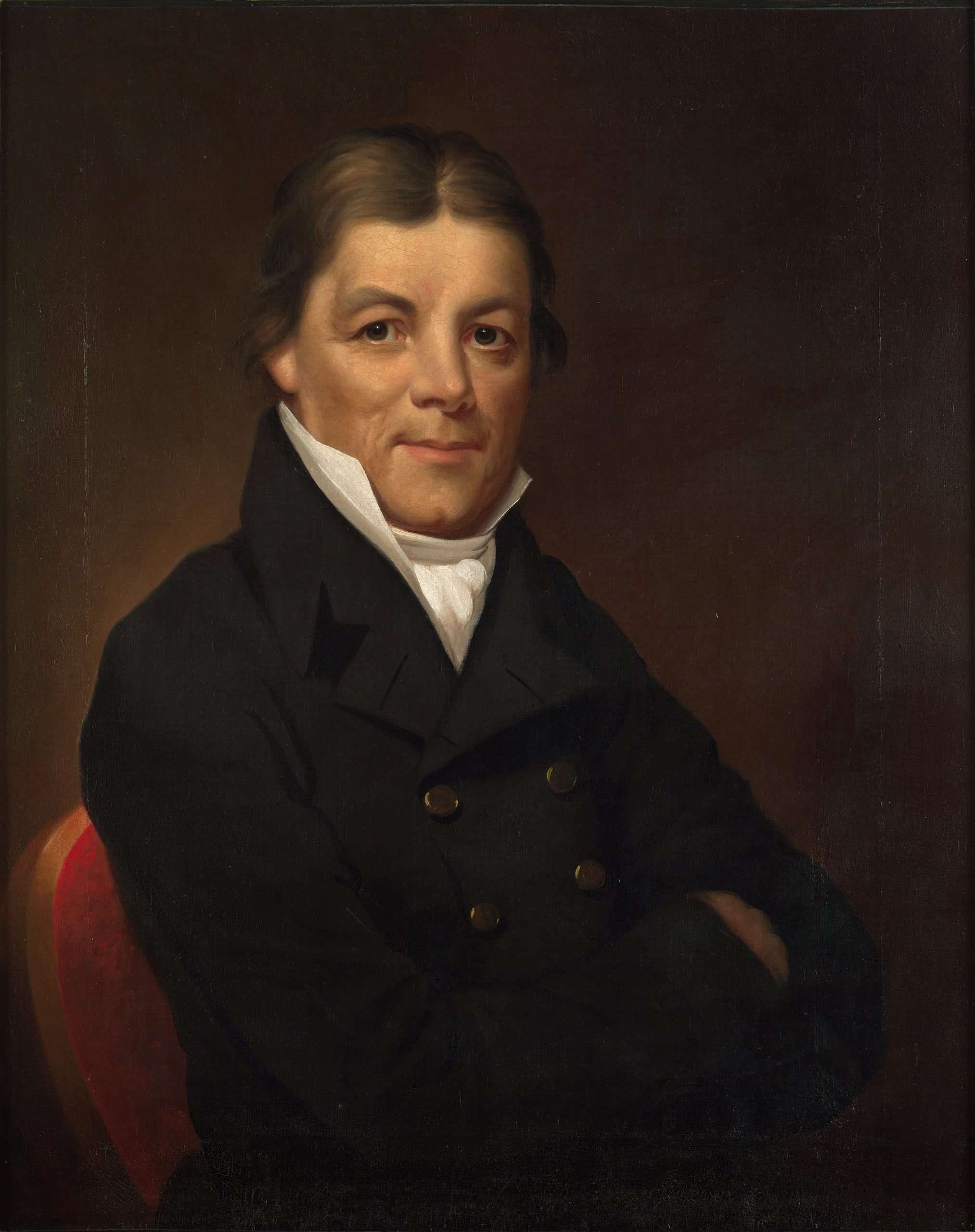
Now, this chronicle of Kirk’s life at Duke is already too long to include a full explanation of John Randolph’s thought and Kirk’s finalized thesis. What’s important to know is that Kirk saw in Randolph a political imaginary: a man who was a friend to federalism but also understood that a strong national government could only exist in those voids which local institutions—the “little platoons”—were incapable of filling. It was Randolph’s Southern conservatism that ultimately led Kirk to call himself later a “Northern agrarian.” Kirk, in the opening pages of his published thesis, explains how he adored Randolph’s:
“alternating ferocity and compassion, his duels, his beautiful letters, his entrancing extemporaneous eloquence, his fits of madness, his sardonic wit, his outbursts of prophecy and his visions of devils, his brandy and his opium, his passionate Christianity, his lonely plantation life, his quixotic opposition to the great political and economic powers of the day.”
In a word, Randolph was everything that Kirk’s classmates were not. He was convicted of his beliefs. As a traditionalist, he loathed industrial society. He was a man of passion, and Christian passion at that. At bottom, Randolph was a real man who engaged in a real world. He had no time for the utopian ideologies or impractical philosophizing of men like Jefferson. He was a politician and a statesman, and as such, he had duties to attend to.
Birzer writes that Kirk’s thesis was, in essence, “an act of piety.” And this, ultimately, was what Kirk had begun learning at Duke. The conservatism Kirk discovered was not simply opposition ot loberalism but the recovery of an inherited tradition—replete with people, institutions, customs, and the ideas that modern America had forgotten.
Kirk thus sought to bring “Randolph up from among the shades,” rescuing his political thought from the past so that it might once again speak to the problems of American politics. In studying Randolph, Kirk was attempting to recover a forgotten political inheritance and place it back into the service of the present. Indeed, Randolph had not simply been forgotten but—owing to the success of Jeffersonian leveling in modern America—had, according to modern liberals, been proven wrong. Kirk sought to dispel this misnomer by situating Randolph as a truly “great man.”
More than that, Kirk believed his recovery of Randolph could help reorient American politics in some minuscule way. Anticipating much of his later work, particularly his writings in The Conservative Mind, Kirk saw in Randolph a prophet of what Alexis de Tocqueville called “soft despotism”: a slow descent of the American Republic into bureaucratic administration and dependence on the state. Looking around at the United States under the New Deal, Kirk thought of Randolph as precisely the voice the nation needed. Randolph not only rejected this soft despotism but fundamentally rejected the premise of egalitarianism—that men are not merely equal in the eyes of God, but possess equal potential and ought therefore to be treated as interchangeable political units. And, to put the cherry on top, Randolph saw tradition and the customs inherited from generations past, rather than positive law alone, as the ordering principles of a nation.
This was all music to the young Russell Kirk’s ears.
Kirk would later say that his study of Randolph “invigorate[d] his political imagination.” However, Randolph’s most lasting contribution to Kirk’s thought was perhaps his role as a midwife of sorts. After all, it was through Randolph that Kirk first encountered Edmund Burke at an intimate level. Kirk says as much in his memoir, writing again in the third person: “About the same time, and in part through his reading of Randolph, he began to apprehend a greater thinker and statesman, Edmund Burke. The power of Burke’s Reflections did for Kirk what it had done for Randolph and many others…it expounded the politics of prescription and convention.” For these reasons and more, Kirk described Randolph as “the American Burke.”
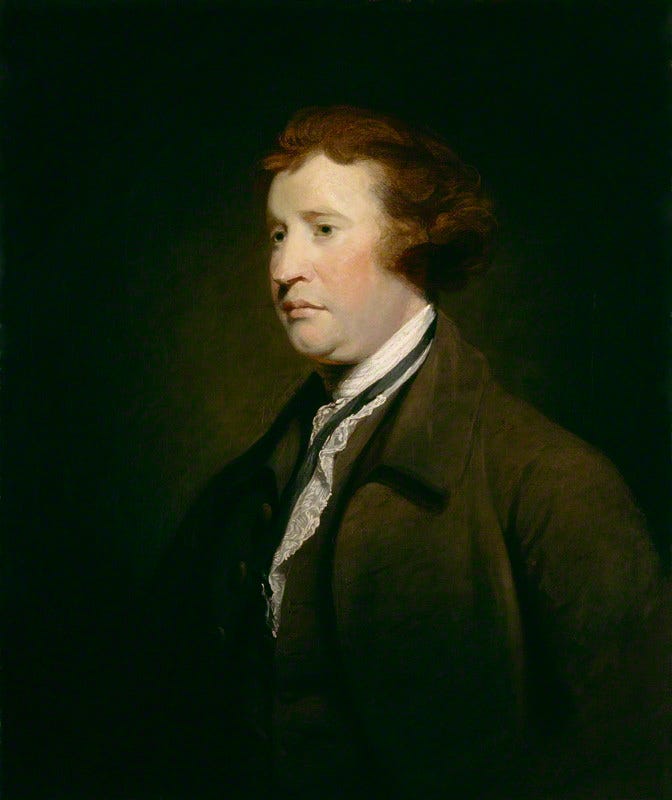
Edmund Burke rocked Kirk’s world. His Reflections on the Revolution in France showed Kirk, perhaps for the first time, what a politics of prudence, prescription, and humility could actually look like. Randolph had given Kirk the political imagination; Burke would give it a philosophy.
Thus, at Duke it could be said that Kirk discovered his political hero.
It is difficult to overstate how monumental this revelation was for Kirk—and, ultimately, for the modern conservative movement. In some sense, it was the modern conservative movement’s equivalent of Marx’s discovery of Hegel: a young intellectual encountering the thinker who would provide the substance for the instincts he had already begun to develop.
So enthralled was Kirk with the thought of Randolph and Burke (and ready to ditch his obtuse classmates) that he finished his master’s thesis in just one year. Birzer notes that, “by April, [Kirk] admitted to finishing each chapter, within a two-day time span.” But before Kirk could leave Duke, he had one last hurdle to conquer: his thesis defense. Kirk described this encounter in the spring of 1941 as a “fierce battle,” owing in no small part to a “scowling, burly, heavily-mustached creature who objected to everything from the title onward, most sincerely.” According to Kirk, the problem was that this man, Dr. William Gibson, was both a political scientist and a nationalist. These two ways of thinking, bent on quantifying and controlling everything, did not mix well with Kirk’s deliberative, organic thought.
Dr. Gibson not only loathed Randolph’s Southern particularism but took issue with Kirk’s usage of the term “political thought” in his title. Kirk’s retelling of the admittedly hilarious exchange, as detailed in a May 1941 letter, has been repurposed below:
[Dr. Gibson]: “Your title is deceptive and false. ‘Political thought’ has a special technical meaning. To be political thought, it has to be unique. What contribution did Randolph make that was unique?”
[Kirk]: “None…nothing has been unique since Aristotle.”
[Dr. Gibson]: “Well, in American political philosophy, I mean.”
[Kirk]: “None. Thought doesn’t have to be unique.”
[Dr. Gibson]: “It does. It’s a special technical term.”
[Kirk]: “I’m not in favor of special technical terms. We’re speaking different languages.”
[Dr. Gibson]: “Your thesis has nothing to do with political thought.”
[Kirk]: “What else could I call my thesis?”
[Dr. Gibson]: *ignoring Kirk’s question* “It’s a special technical term.”
[Kirk]: “Well, I’m no great philologist…”
[Dr. Gibson]: “It’s not a matter of philology. It’s a matter of definition and history and meaning.”
[Kirk]: “What is your special technical meaning of ‘philology?’”
Supposedly, their debate went on and on like this for a while. This episode, like Kirk’s other encounters with Duke’s faculty and students, is revealing. It illustrates precisely the sort of academic snobbery and intellectual conformity that Kirk loathed. He had little patience for such people.
Though this quarrelsome professor was “no gentleman,” he ultimately assented and voted with his colleagues to approve Kirk’s thesis. This was largely the result of the “history men” like Dr. Sydnor who went to bat for Kirk during the defense. The final product of his year of study and masterful defense of his thesis would become Kirk’s first book, published by the University of Chicago Press in 1951: Randolph of Roanoke: A Study in Conservative Thought. Kirk was proud of this achievement. He wrote in The Sword of Imagination, “Perhaps no other master’s thesis in American history, written in the space of eight months, has enjoyed such long life in print, even unto this very day.” In a separate letter around the conclusion of his time in Durham, Kirk mentioned to a friend, “I hope to write a book of biographical sketches of the Old Republicans…”
Birzer appears to conclude that this letter of Kirk’s, revealing his ambitions to write a Plutarchesque set of sketches of conservatives, coupled with his newfound love affair with Edmund Burke, was the moment when Kirk first set his mind to writing something like The Conservative Mind. Whether that is true is, of course, debatable. What is clear beyond any doubt is that, by the end of his time at Duke, Kirk had found a friend in Burke and had a stated ambition to chronicle the intellectual histories of various conservative minds.
Kirk’s Meager Social Life
Before I finish this tale, it’s worth touching a bit on Kirk’s personal life while at Duke. As already noted above, Kirk did not like the people at Duke all that much. There were some professors and a friend or two, but, on the whole, the campus was not very welcoming to the young “Sage of Mecosta.”
Even during his attenuated travels across the South with classmates, Kirk spoke more in his letters and memoir about the places themselves than about his fellow travelers. Apart from his friend, Robert Purcell, everyone else was a sort of vague archetype, a “classmate,” a “roommate,” or a “professor.” They were not really people in the way that Randolph and Dr. Sydnor were. In truth, if you read Kirk’s recollections of his travels, he always speaks highly of the places themselves and their history but never fails to disparage the people. For example:
“At Chapel Hill, all the walks are of a sort of sand-and-gravel; one of the benefactors of the University specified that if they ever put in concrete walks, they would lose his bequest. The students and faculty who pride themselves on belonging to the most ‘liberal’ institution in the South, and think change means reform, are forever trying to have hot and hideous cement substituted, but as yet they’ve been able to find no loophole in the bequest.”
There’s no record of Kirk joining a fraternity or club on campus—believe me, I read through every extant edition of the Duke Chronicle from his time. The only thing he did, apart from reading about Randolph and the other Southern conservatives, was grade papers for a freshman European history course.
Kirk supposedly had a bit of a love affair while down in Durham, though the girl was someone he met during a visit to Florida. This anonymous liberal arts student was, according to Birzer, one of three girlfriends Kirk had before he met his future wife, Annette Kirk. It seems the only hint of an extracurricular social life we get comes from his memoir, where Kirk wrote:
“The only place (aside from fraternities) for socialization was a snack counter with a half-dozen stools. The graduate students had their own dining room, with waiters and plenty of peanut butter, and their own dormitory, two to a room.”
Perhaps Kirk’s distance and generally melancholic state of mind can be explained by his longing for home, specifically his mother. As I mentioned at the beginning of this piece, Kirk had a very close relationship with his mother. She was the person who introduced him to his lifelong love of literature. The two regularly shared books and letters by mail. Sadly, while Kirk was at Duke, his mother began to experience symptoms of intestinal cancer. Throughout the early 1940s, her health quickly declined before she ultimately succumbed in the early months of 1943.
The usually stoic Kirk was perhaps not broken but certainly disheartened by this dreadful news. He was losing his mother, and there was a chance he would not be there to say goodbye. One can only imagine the cloud this must have cast over his time in Durham. This is shown on full display in a February 3rd, 1941, letter he sent to his mother:
“Dear Mama,
Perhaps when you receive this you will have had your final operation and will no longer have to worry about that. If you recover from its effects as rapidly as you did from those of the first one, you’ll be feeling fine when I come home in March. Are you in the same room in the hospital as you were before? You will have to tell me all about your new roommates. When will you be going home again? Be sure not to move until you feel well enough. I wish I could have your operation for you; it probably would help me lose some of my fat (although I have reduced slightly, of late, I think).”
Kirk loved his mother in a truly admirable way. You can see it in his almost desperate questions to inquire about her health as well as his feeble attempt at the end to lift her spirits with a bit of self-deprecation.
Conclusion
Whether it was his mother’s declining health, the lack of intellectual rigor, or the intrusion of Yankees, it’s quite clear that Kirk did not enjoy his time at Duke. And yet, for all his complaints, Duke may have been the most intellectually consequential year of his young life.
Rather ironically, he treated Duke and the South at large much like the so-called carpetbaggers did in the sense that he swooped down from the North, pillaged its intellectual resources, and carried them off to his little getaway on Piety Hill.
As Birzer wrote in American Conservative, “nothing personal held Kirk in the South.” His roots were elsewhere—perhaps in a hospital bed somewhere in Michigan. Though his friends, Drs. Sydnor and Hubbell, attempted to keep Kirk at Duke to pursue his P.h.D., he was unaware of this until a few years later (contra Birzer’s suggestion that Kirk openly declined the offer). After a tenure in the Army, Kirk would ultimately wind up at St. Andrews University in Scotland, where he wrote a little-known dissertation titled The Conservative Mind: From Burke to Eliot.
Kirk came to Duke looking for a job. In Durham, he discovered a lifelong intellectual vocation.
I think it’s best to end Kirk’s time at Duke and the South more generally with his own recollection:
“Kirk had found in the South a conservative society that had been struck a fearful blow eighty years before and still sometimes seemed dazed by that stroke; but he liked its life far better than the life of Detroit. In the South, then and later, he learned that some of the more oppressive ‘problems’ in life never are solved, unless by Time and Providence. He read deeply about the South ‘befo’ de wah’ and poked into its ashes. In Richmond and Charleston he found communities that had not surrendered unconditionally to the new order of American life.”
Further Reading (in no particular order)
Russell Kirk: American Conservative (Birzer)
Imaginative Conservatism: The Letters of Russell Kirk (ed. Person Jr.)
The Sword of Imagination: Memoirs of a Half-Century of Literary Conflict (Kirk)
Russell Kirk: A Critical Biography of a Conservative Mind (Person Jr.)